2026 Compliance Alert: 5 Updated Chemical & Labeling Regulations Your Backpacks Must Meet for US & EU Export (With Checklist)
As we move through 2026, regulatory landscapes in the US and EU are rapidly evolving, with stricter enforcement on chemical safety and product labeling. For DTC brands and sourcing managers, this isn't just a compliance issue—it's a critical business risk affecting market access, customs clearance, and brand reputation. At OSAMIC, we navigate these complexities daily. Here is your essential guide to the five most crucial regulatory updates for backpack exports this year.
1. EU REACH: The Ever-Expanding List of Controlled Substances
The EU's REACH regulation remains the cornerstone of chemical management, with its list of Substances of Very High Concern (SVHCs) continually growing. Coatings, dyes, plastic components, adhesives, and even fabrics in your backpack could contain restricted substances.
Key Changes & Risks for 2026:
SVHC List Expansion: The Candidate List now exceeds 235 substances, with more additions expected. If any component contains an SVHC above 0.1% (by weight), you have communication obligations. Notification to ECHA is required if the total volume exceeds 1 tonne per year per substance.
Tighter Annex XVII Restrictions: Limits on various phthalates and Polycyclic Aromatic Hydrocarbons (PAHs) are broadening. Certain plasticizers used in synthetic leather or rubber components may face new restrictions.
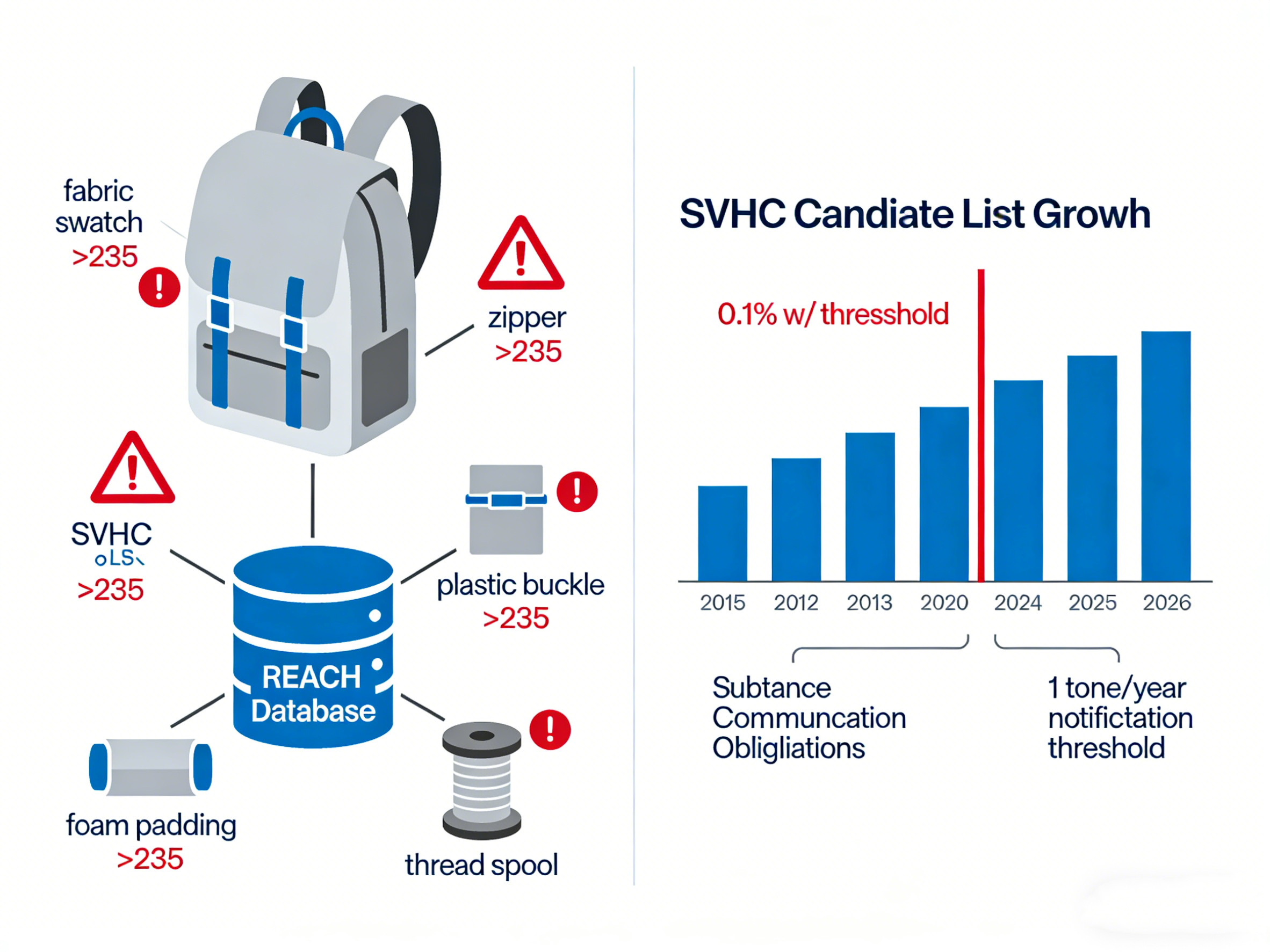
The OSAMIC Advantage: We maintain a dynamic restricted substances database for all core materials. We mandate that our suppliers provide full material declarations and current REACH compliance test reports. For new developments, we screen material choices for compliance at the design stage.
2. EU CLP Regulation: The Tightening Timeline for Label Updates
The EU's Classification, Labelling and Packaging (CLP) Regulation sets stringent rules for labeling hazardous mixtures, including any care products (e.g., cleaner, protector spray) sold with your backpack.
Critical 2026 Deadlines:
6-Month Label Update Rule: If the hazard classification of a mixture changes based on new information, suppliers must update the label within 6 months. This demands extremely efficient information flow in your supply chain.
Digital Labeling Option: The regulation now formally allows digital labels (e.g., QR codes) as a voluntary option to supplement or replace some physical label information—a solution for small packaging.
Strict Advertising Claims: Using misleading claims like "non-toxic," "harmless," or "eco-friendly" for products containing hazardous chemicals is prohibited. Relevant hazard pictograms must be included in ads.
The OSAMIC Advantage: We connect you with compliant chemical suppliers for any ancillary products and provide label templates that meet the latest CLP format requirements. At OSAMIC, we commit to using only European-standard, non-hazardous fabrics, ensuring the core product itself is safe and compliant.
3. UK GB CLP: An Independently Evolving Mandatory List
Post-Brexit, the UK operates its own GB CLP system. Its GB Mandatory Classification and Labelling (GB MCL) list is updating independently, creating a new compliance frontier.
2026 Development:
The UK plans to introduce new or revised classifications for around 60 chemical substances, including various copper and boron compounds potentially used in industrial applications.
New classifications are expected to be adopted in Q2 2026, with a transition period before becoming mandatory in Q4 2028.
Impact on Your Backpack: If your product uses treatments containing copper compounds (e.g., certain antimicrobial coatings) or boron compounds, you may need to update Safety Data Sheets and labels for the UK market in the near future.
4. EU's New PPWR: Chemical Safety Meets Packaging Waste
The 2025 Packaging and Packaging Waste Regulation (PPWR) focuses on sustainability but will significantly impact the chemical safety of packaging materials.
2026 Milestone:
The European Chemicals Agency (ECHA) is studying hazardous chemicals in packaging to assess their impact on safety and recyclability, with a priority list of substances for restriction due in 2026.
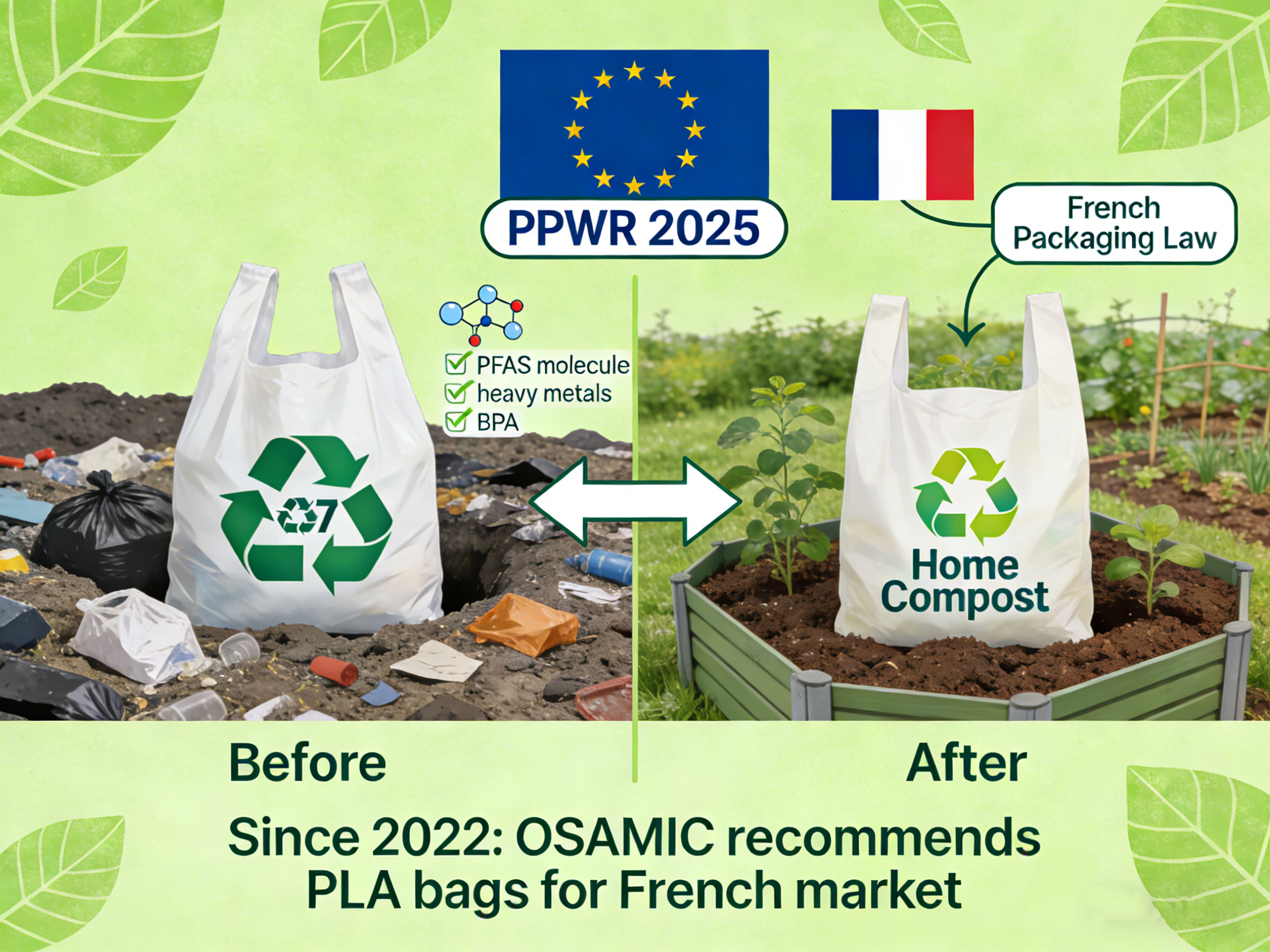
Substances like PFAS ("forever chemicals") used in packaging are likely to face heightened scrutiny and potential bans.
Impact on Your Backpack: This directly targets your product's retail packaging—polybags, cartons, hangtags, and printing inks. Proactively assessing and verifying the composition of your packaging materials is now essential.
OSAMIC's Proactive Step:We have been advising our clients targeting the French market since 2022 to switch to home-compostable PLA bags instead of traditional plastic polybags, ensuring alignment with the stringent French Packaging Law and broader PPWR principles ahead of the curve.
5. EU PIC Regulation: Deep Supply Chain Scrutiny
The Prior Informed Consent (PIC) Regulation governs the import and export of certain hazardous chemicals, and its list is updated in line with REACH.
The Hidden Risk: While it directly regulates substance trade, if your manufacturing process relies on chemicals that are banned or restricted for export under PIC (e.g., certain plasticizers, UV absorbers), it could disrupt your upstream supply chain and halt production.
Backpack Export Compliance: Self-Assessment Checklist
Use this actionable checklist to manage your regulatory risk systematically.
Checkpoint
| Key Question to Ask | Key Question to Ask |
|
1. Substance Restrictions | Do all materials (fabric, coating, plastic, adhesive, dye) comply with the latest REACH Annex XVII restrictions? | Obtain up-to-date REACH compliance statements and test reports from all material suppliers. |
| Does any component contain an SVHC above 0.1% w/w? Are information obligations being met? | Create a material composition spreadsheet. Prepare safety data sheets for downstream communication. |
| Has the product and its packaging been screened for PFAS and other high-profile substances? | Proactively screen for high-risk substances and explore compliant alternatives early in the design phase. |
2. Classification & Labeling | Have any chemical mixtures (e.g., care products) been classified based on the most recent data? | Confirm classification status with your chemical supplier and obtain the latest Safety Data Sheet (SDS). |
| Do physical labels for these mixtures comply with CLP rules for pictograms, signal words, and hazard statements? | Audit label format details. Establish a process to update labels within the 6-month deadline. |
| Have you considered digital labels (QR codes) to manage complex information needs? | Evaluate digital labeling solutions to enhance user experience and future-proof your compliance. |
3. Market-Specific Rules | For UK exports, have you screened formulations against the 60 substances proposed for the GB MCL list? | Monitor updates from the UK Health and Safety Executive (HSE). Pre-screen raw materials. |
| Does product advertising avoid misleading claims like "non-toxic" for items containing hazardous mixtures? | Review all marketing copy for compliance with CLP advertising rules. |
4. Packaging & Supply Chain | Do retail packaging materials align with PPWR's principles for reducing harmful substances and environmental burden? | Switch to compostable PLA bags instead of standard polybags. Request full disclosure from packaging suppliers. |
| Are the chemical raw materials in your supply chain free from substances banned for export under the EU PIC regulation? | Conduct due diligence on your chemical suppliers to ensure they source compliant raw materials. |
5. Ongoing Vigilance | Do you have a system to monitor updates to the REACH SVHC, EU CLP, and GB MCL lists? | Subscribe to regulatory update services or partner with a manufacturer (like OSAMIC) that monitors these changes. |
| Is there a clear process for suppliers to communicate chemical safety information updates to you? | Establish formal agreements with suppliers for immediate notification of any compliance-related changes. |

Navigating this complex landscape requires a proactive partner. At OSAMIC, regulatory compliance is integrated into our development and production processes. From material vetting to final labeling, we ensure your products are built for seamless market entry.
Contact OSAMIC today to discuss how our compliance-first manufacturing approach can de-risk your next backpack launch.